Stop Rubbing Industrial Seed Oils Into Your Family's Skin
We cleaned up our kitchen years ago, no seed oils, nothing processed. Then one night I actually read the back of our “natural” moisturiser, and there it was: sunflower oil, third ingredient. I'd been rubbing the exact thing I'd banned from the pantry into my kids' skin every night. Rachel, 42, NSW

If you're the kind of person who reads ingredient labels in the supermarket aisle, you already know things most people never bother to learn.
You know why the seed oils left your kitchen: industrial processing, oxidation, inflammation, ingredients your great-grandparents wouldn't have recognised as food. You've done the work. The pantry is clean, the cooking fats are traditional, and you feel good about what goes into your family. But here's the blind spot almost everyone in this movement shares: walk into your bathroom, pick up the moisturiser, the “natural” baby lotion, the sensitive-skin cream, and read the back. Sunflower oil. Canola. Soybean. Safflower. The very oils you banned from the frying pan, being absorbed through the largest organ your family has, twice a day, every day.
And once you've seen it, you can't unsee it. You know the feeling of standing in the bathroom at some odd hour, turning jar after jar around, realising the clean-up you did in the kitchen never made it past that door: how did I miss this?
What you're about to read is the story of how those oils got into your bathroom in the first place, it was never about your skin, and always about profit, and how a simple, three-ingredient Australian balm is letting families finish the clean-up they started in the kitchen: one honest jar, nothing to hide, gentle enough for every pair of hands and cheeks in the house.
Here are the 5 reasons thousands of label-readers are putting the seed-oil creams in the bin, where the seed oils went, and reaching for Aus Tallow Balm instead.
The Oils You Banned From Your Kitchen Didn't Leave, They Moved Into Your Bathroom
You probably already know the first half of this story. In the early 1900s, industrial processors found themselves with mountains of cheap cottonseed and vegetable oils, by-products they'd been selling as machine lubricant, and needed somewhere to put them. The answer was your great-grandparents' kitchen: hydrogenate it, call it modern, and market it as an upgrade on the traditional animal fats people had cooked with for thousands of years.
Here's the half of the story that rarely gets told: the beauty industry made exactly the same trade, for exactly the same reason. Traditional skincare was built on animal fats, tallow above all, because they were nourishing, stable, and remarkably close to the skin's own oils. But tallow can't be produced by the tanker-load, and it can't sit in a warehouse for three years. Polyunsaturated seed oils can. So through the twentieth century, the fat your grandmother's grandmother rubbed into her hands was quietly swapped out for canola, sunflower and soybean oil, dressed up with silicones, synthetic fragrance and preservatives, and marketed as “modern,” “light” and “science-backed.”
And the labelling rules give them cover. “Fragrance”, one word on the back of the jar, is legally allowed to stand in for a proprietary blend of undisclosed chemicals. Each ingredient is used in doses deemed “safe enough” in isolation. But nobody applies a moisturiser in isolation. Your family layers these formulas on twice a day, year after year, over the body's largest and most absorbent organ, and unlike the food versions you've already dealt with, these seed oils don't even pass through digestion first. They sit on the skin's surface, where polyunsaturated fats are prone to doing what they always do when exposed to light and air: oxidise.
You wouldn't cook your family's dinner in it anymore. Why is it still going on their skin?
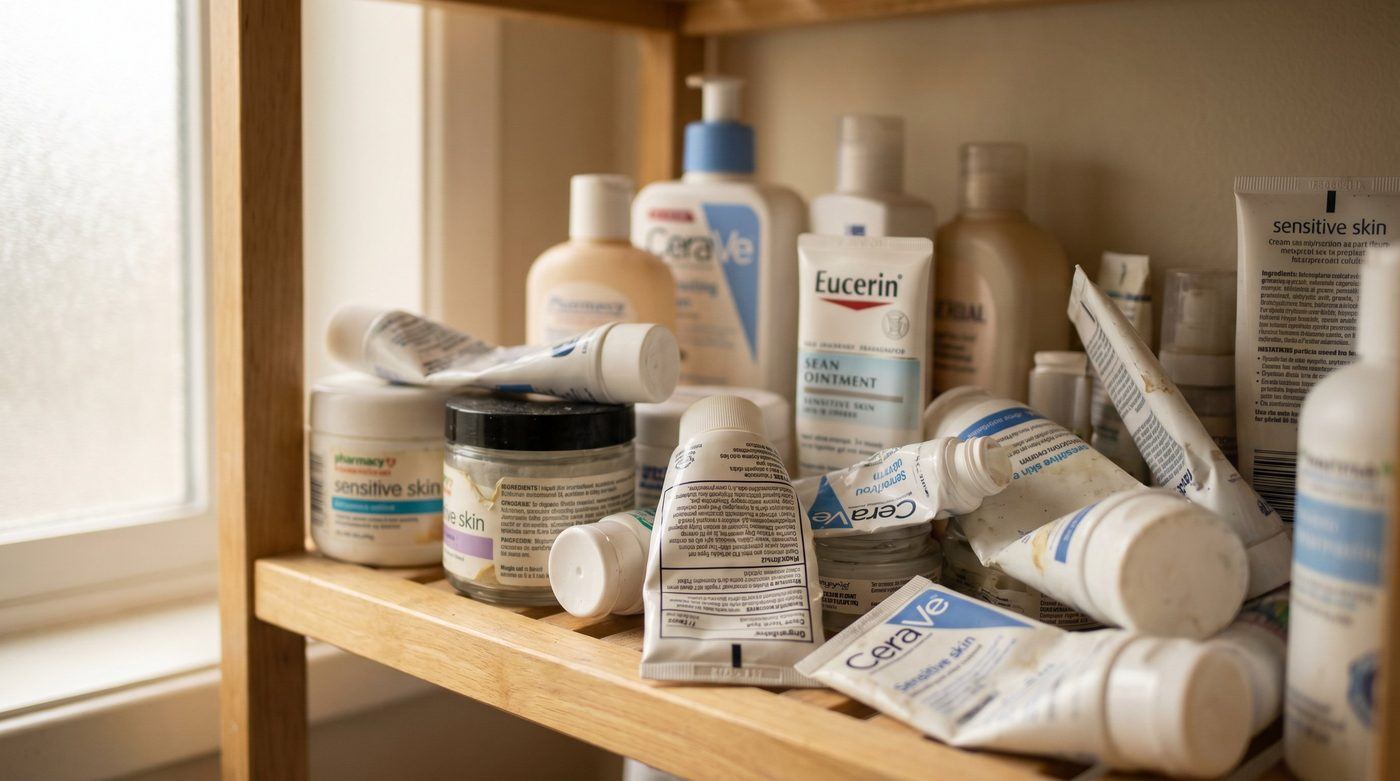
This isn't a gap in your diligence. The kitchen swap was loudly debated, so you caught it. The bathroom swap happened silently, behind friendly words like “botanical” and “nourishing”, and even most “clean” brands still build on the same cheap seed-oil base. The good news: the fix is the same one you already made in the kitchen. Go back to the traditional fat the industry replaced. Which is exactly what the next reason is about.
Your Skin Can't Recognise Industrial Chemistry, But It Recognises Tallow Almost Instantly
If you've spent any time in real-food or ancestral-living circles, you've already heard the whispers: the same people who brought tallow back into their kitchens started putting it on their skin, and the results made them wonder why anyone ever stopped.
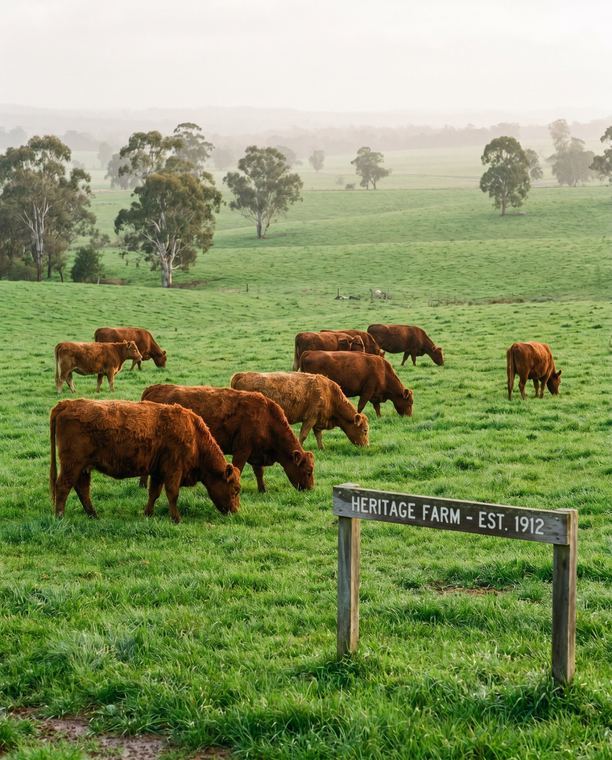
Long before pharmacies, lab-made preservatives, and "active ingredients," people cared for raw, chapped, and irritated skin for centuries using animal fats. The most prized of all was tallow, the rendered fat of grass-fed cattle.
The reason isn't mystical, it's biology, and it will make immediate sense to anyone who thinks about food the way you do. Grass-fed tallow is remarkably similar to sebum, the natural oil your own skin produces to protect and repair itself. Its fatty-acid profile, and its natural fat-soluble vitamins A, D, E, and K, are so close to what human skin already makes that the skin doesn't treat it as something foreign to fight off. It's the topical version of the principle you already live by: eat (and wear) what your body recognises.
Where an industrial seed-oil cream arrives as a stranger the skin has to defend against, traditional tallow arrives as something it seems to simply recognise.
There's nothing to reject. Nothing to sting. Instead of sitting on top in an oxidising film the way seed-oil lotions tend to, it melts in and is absorbed, delivering stable, saturated nourishment to skin that's been living on industrial substitutes for decades.
This is why tallow was the default skin food of humanity for thousands of years, Egypt, Rome, medieval Europe, traditional cultures on every continent, right up until the industrial swap. It isn't a trend being rediscovered by influencers; it's a tradition being reclaimed by people like you, who did the reading. It's not a formula forcing a change. It's a simple, familiar fat giving skin back what the twentieth century took out of the jar.
Which raises the question every serious label-reader asks next, and should: if tallow is so good, aren't all tallow balms basically the same? And how do I know this one isn't hiding something further down the label?
Not All Tallow Is Equal, Why "100% Australian, Three Ingredients" Is the Part That Actually Matters
Here's the thing no one selling tallow wants you to look at too closely: the word "tallow" on a label tells you almost nothing.
A jar can say "tallow balm" and still be made from cheap fat trimmings of unknown origin, rendered fast and cheap, then padded out with fragrance, essential oils, and, yes, the same seed oils you were trying to escape. Plenty of "natural" balms online do exactly this. The category got popular, and the corner-cutting followed.
The honest question isn't "is it tallow?" It's whose tallow, from what animals, raised on what, and what else is in the jar?
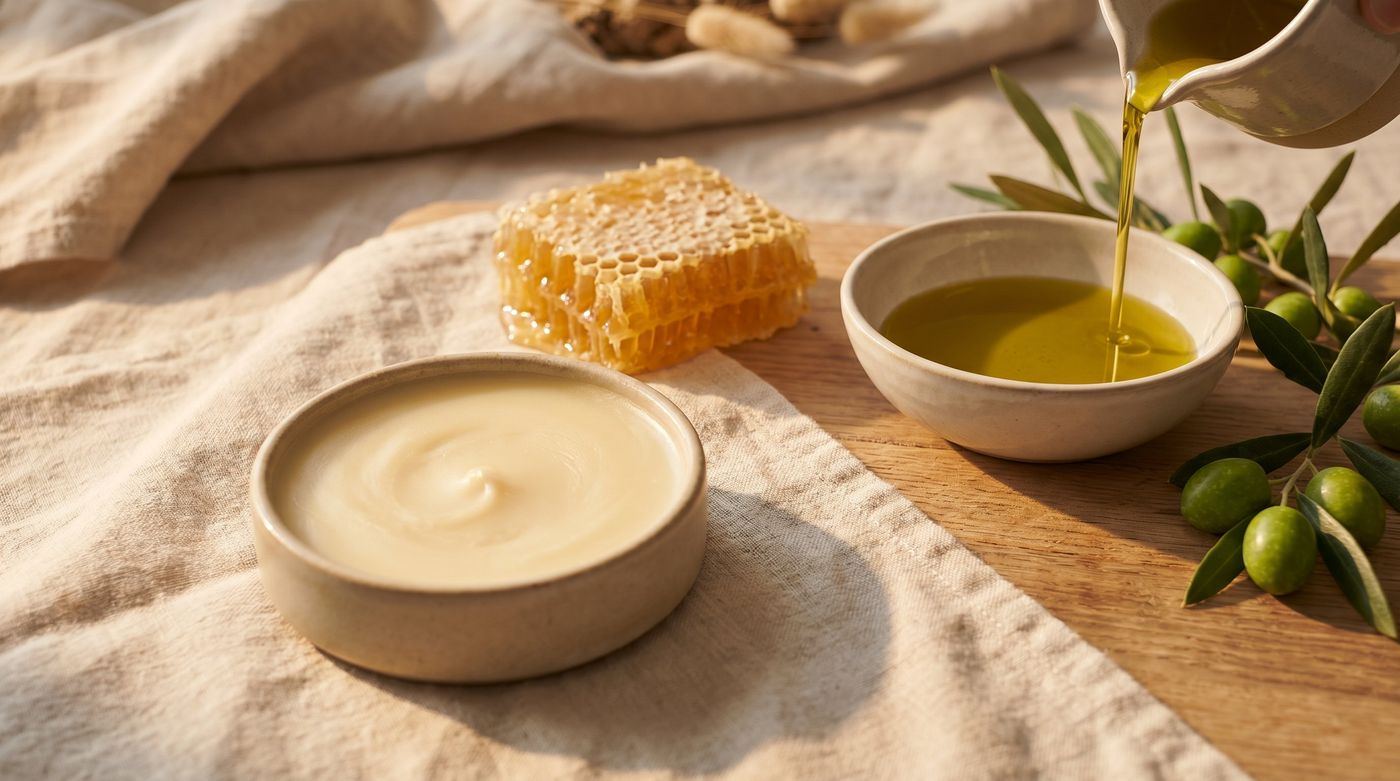
Aus Tallow Balm was built around answering that question with something you can read in three seconds. Just three ingredients:
Australian Grass-Fed Tallow
Rendered from pasture-raised cattle on Australian soil, not grain-finished feedlot fat shipped in from overseas. Grass-fed is naturally richer in the fat-soluble vitamins A, D, E & K and the CLA that give it its nourishing, soothing character. This is the ingredient doing the heavy lifting.
Pure Australian Beeswax
From local hives, it forms a gentle, breathable protective layer that helps fragile skin hold its moisture and shields it from the harsh Australian sun, wind and dry air, without any synthetic film.
Australian Extra-Virgin Olive Oil
Cold-pressed and local, naturally high in the antioxidants and polyphenols that make it soothing and calming on sensitive skin.
What's in the jar
- Grass-fed Australian tallow
- Pure Australian beeswax
- Australian extra-virgin olive oil
What's never in it
- Fragrance & parabens
- Phenoxyethanol
- Seed oils & fillers
That's the entire list, and it's the whole point. No “fragrance” hiding a hundred undisclosed chemicals. No parabens. No phenoxyethanol. No seed oils smuggled in at position seven where most people stop reading. No fillers to pad out the jar or stretch the shelf life. Three ingredients you can pronounce, picture, and if you wanted to, eat. There is nowhere on this label for anything to hide.
And every part of it is Australian-sourced and handcrafted here in small batches, which means you're not just trusting a buzzword on the front of the bottle, you're trusting something traceable: tallow from Australian pastures, beeswax from Australian hives, olive oil from Australian groves. For skin facing Australian conditions, that local origin isn't marketing, it's the whole point.
Put any “natural” or “clean beauty” lotion next to this and try to read its label out loud. Twenty-five, thirty ingredients, botanical hero on the front, sunflower oil doing the cheap work on the back. Then read ours: tallow, beeswax, olive oil. Full stop. That contrast is the reason label-readers make the switch, and why they tend to bring their whole household with them.
What Families Actually Notice, and How Quickly
When households make the switch, and it does tend to be households, not individuals, they describe the change in a strikingly similar order. Here's the pattern we hear again and again.
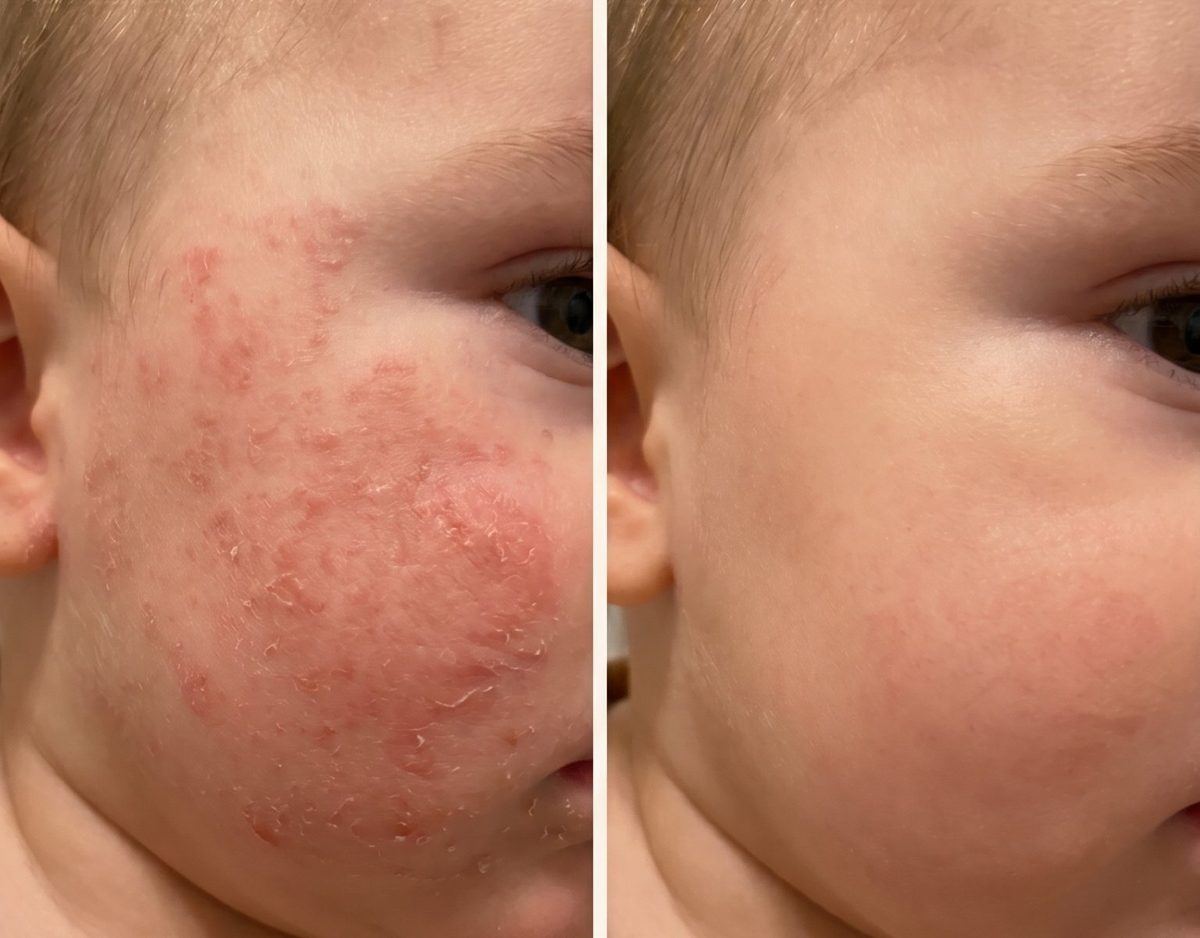 Day 1
Day 30
Day 1
Day 30
The first thing people notice is relief of a different kind: the mental sort. Smoothing something onto your child's cheeks, or your own, without a single ingredient you'd have to explain away. It melts in with no perfumed cloud and no greasy film, and the label-reader's background hum, what's actually in this?, goes quiet for the first time in years.
Skin starts telling you what it thinks of the upgrade. Dry patches look calmer and less raw. The tightness after showers eases. Kids stop complaining that the cream “stings”, because there's nothing in the jar to sting with, and the jar starts migrating around the house: bathroom, kitchen bench, bedside table.
This is when the messages land in our inbox, usually with a family inventory attached: mum's face, dad's work-cracked hands, the toddler's cheeks, someone's elbows. Skin across the household that was rough, flaky and irritated looks smoother, softer and genuinely settled, on one shared jar, with one label everybody trusts.
The bathroom shelf starts to look like your pantry did after the clean-up: shorter, simpler, honest. The seed-oil lotions go where the seed oils went. And the clean-living project you started in the kitchen finally covers the whole house, and everyone in it.
A little goes a long way, so one jar tends to last a good while even covering a whole family, which works out to just cents a day for something you can use on every pair of hands and cheeks in the house without a second thought, or a second glance at the label.
There's a deeper satisfaction here for people like you, and you know it because you felt it in the kitchen. Every jar is a small withdrawal from the industrial system that made the swap in the first place, and a vote for the traditional one: grass-fed Australian cattle, local hives, Australian olive groves. You're not just avoiding what you don't want on your family's skin. You're funding what you believe should exist.
We're a Small Australian Operation, and We Intend to Stay That Way
Here's something the big skincare brands will never say out loud: we're not trying to become one of them, because becoming one of them is exactly how tallow got replaced the first time.
Every jar of Aus Tallow Balm is made here, by hand, in small batches, Australian grass-fed tallow rendered slowly the traditional way, blended with local beeswax and Australian olive oil, and nothing else.
That's a deliberate choice, and it comes with two consequences worth being honest about.
First, it's something the big brands genuinely can't replicate. Their entire model depends on products that can sit on a warehouse shelf for years, made from synthetic ingredients they can mass-produce by the tanker-load and stretch with cheap fillers. A pure, three-ingredient balm with no preservatives, made in small batches, is the opposite of how they're built to operate. We don't have shareholders to answer to or margins to protect by cutting corners. We have a simple standard, only what we'd happily put on our own family's skin, and we won't move off it.
Second, it means we do sell out. We render slowly, we batch small, and we won't rush it or outsource it to a factory to keep up with demand. And word travels unusually fast in your world, one mention in a real-food forum or a homestead group and a batch is gone. If there are jars available as you're reading this, that genuinely won't always be the case, and a restock isn't instant.
So if tonight's the night you go and read the back of the jars in your bathroom, and we suspect it might be, this is your moment to have the replacement already on its way.
One Honest Jar, With Nothing to Hide
Right now, Aus Tallow Balm is available exclusively through our official website, and it comes with a 60-day money-back guarantee. If it doesn't earn its place as the whole household's jar, send it back, even empty, for a full refund.
Place your order
Secure your jar today while we have stock available.
It arrives fresh
In just 3–7 business days, your fresh jar lands at your door.
Finish the clean-up
Read the label one more time, all three words of it, then retire the seed-oil jars for good.
Know someone who cleaned up their kitchen but hasn't checked their bathroom yet, a sister, a friend, someone in your real-food group? Our bundle deals are an easy way to pass along a jar as a genuine "read the back of your moisturiser" gift that finishes the job for them.