You've spent years and a small fortune doing everything right. Your skin got worse anyway. Here's what's actually going on, and why the fix isn't another product.
None of this is a conspiracy. It's just cheaper, and nobody made you read the back.
Aqua is the first ingredient on many mainstream creams, which means it is the largest by weight. Much of what is in the jar evaporates off your face within minutes. The active part is the thin bit left behind.
Surfactants strong enough to feel squeaky-clean also strip the lipid layer that holds your moisture in. Then you need the moisturiser. Then you need more of it. Each product solves the problem the last one created.
Seed oils are cheap, colourless and odourless, so they're perfect bulking agents. On a label they appear in Latin, which makes canola read like a botanical extract. Nothing about the word "clean" is legally defined in Australia.
On the left, a representative ingredient list from a mainstream "hydrating, sensitive-skin" cream. On the right, ours. Same job. Same shelf.
Aqua, Glycerin, Helianthus Annuus Seed Oil, Cetearyl Alcohol, Caprylic/Capric Triglyceride, Brassica Napus Oil, Butylene Glycol, Dimethicone, Glycine Soja Oil, Phenoxyethanol, Cetyl Alcohol, Carbomer, Sodium Hydroxide, Parfum, Xanthan Gum, Disodium EDTA, Tocopheryl Acetate, Carthamus Tinctorius Seed Oil, Panthenol, Sodium Benzoate, Ethylhexylglycerin, Citric Acid, Potassium Sorbate, Linalool, Limonene, Hexyl Cinnamal, CI 77891
Grass-Fed Australian Tallow Australian Beeswax Australian Extra-Virgin Olive Oil
The highlighted entries are the four seed oils and the fragrance blend. They're printed in Latin because the botanical name is the legal name — not because anyone is hiding it, but because almost nobody translates it standing in the aisle.
This isn't your skin being difficult. It's a closed circuit, and it runs the same way for almost everyone.
Water and humectants make skin feel plump within seconds. That's the sensation you're paying for, and it's real — for about an hour.
Polyunsaturated seed oils are less stable than saturated fats. Exposed to air, light and skin warmth, they oxidise, and oxidised lipids can irritate the barrier they were meant to protect.
The water leaves and takes some of your own moisture with it. Skin ends up drier than before you applied anything. This is rebound dryness.
Tightness returns, so you reach for the jar again. Consumption doubles. From the manufacturer's side of the table, nothing here is broken.
Every product that needs reapplying by lunchtime is telling you something about itself.
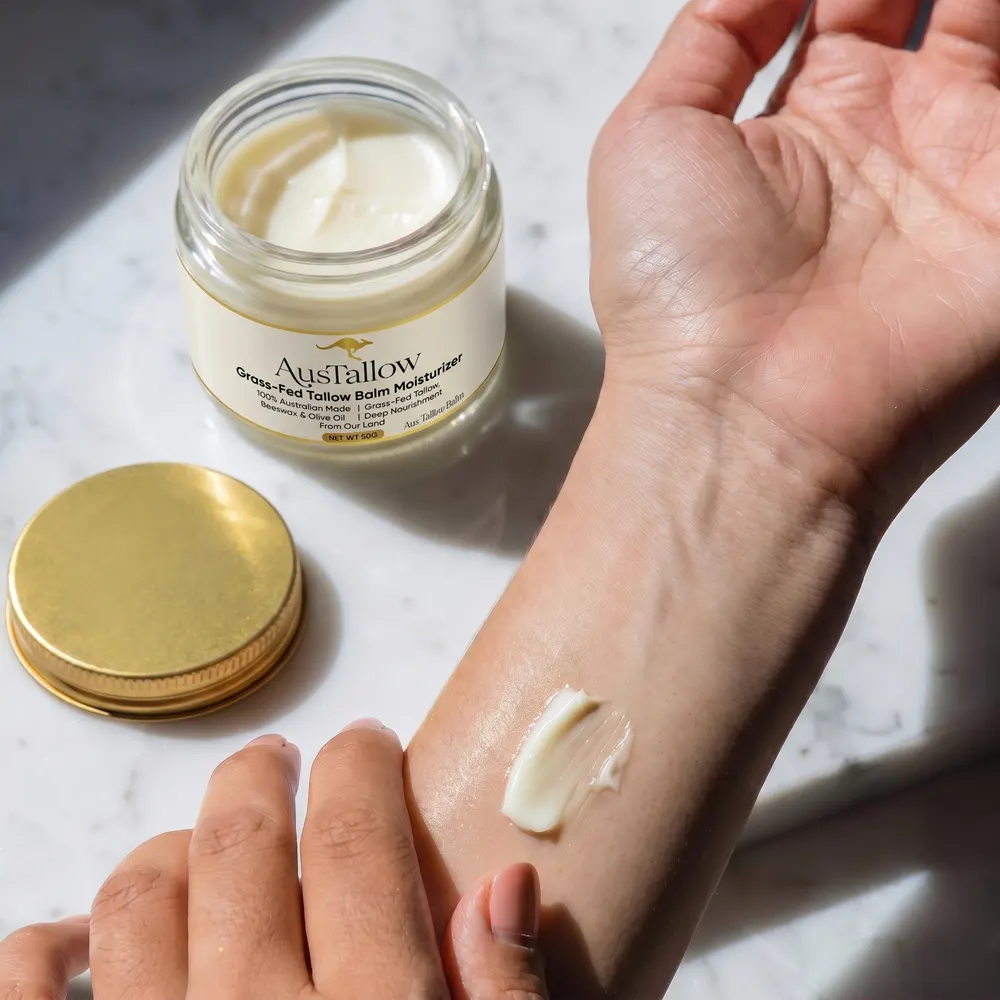
Your skin makes its own protective oil: sebum. Grass-fed tallow's fatty-acid profile mirrors human sebum more closely than any plant oil on earth — which is why it behaves less like something applied and more like something replaced.
It isn't a trend. It's what skincare was for ten thousand years, right up until something cheaper could be poured into the same jar.

You don't need to trust us on any of this. Pick up whatever you're currently using and check four things on the back.
Read the full ten-second label test → Five steps, any bottle, any aisle, no chemistry required.
If it passes, keep using it. Honestly. We'd rather you kept something that works than bought something that doesn't.
| AusTallow | Typical "hydrating" cream | |
|---|---|---|
| Ingredient count | 3 | 25–40+ |
| Seed oils | Never | Often in the top 5 |
| Water as main ingredient | 0% | Often ~70% |
| Mirrors your skin's own sebum | ✓ | ✗ |
| Synthetic fragrance & parabens | None | Common |
| Face, hands and whole body | One jar | A product each |
| Made in | Australia, small batches | Commonly offshore |
| Guarantee | 60 days, even empty | Varies by brand |
I threw away seventeen creams after this one. My hands have never looked or felt better.
Three ingredients, one jar, sixty days to decide. If your skin isn't calmer and softer, send it back even empty and we'll refund the lot.
Shop The Tallow Balm →